Food Safety

Our Approach

Hershey is committed to creating more goodness inside by delivering quality products that meet the highest food safety standards in the industry. We go beyond compliance with national and international standards, and every part of our manufacturing process is subject to rigorous auditing and oversight.

We take a preventive approach to food safety and quality. Hershey’s Product Excellence Program (PEP) is our comprehensive quality management system that is designed to identify, reduce and eliminate risk through the entire product lifecycle including product design, supply chain, production and distribution to the customer. Through this system, we identify potential risks and implement controls and monitoring to ensure the safety and quality of our products.

The Quality Center of Excellence team oversees the PEP to ensure its rigorous controls, monitoring and auditing practices are applied throughout the value chain. The Global Regulatory team continually reviews and evaluates emerging regulations and industry practices to ensure that we meet the latest requirements and best practices.

The PEP meets or exceeds current Global Food Safety Initiative (GFSI) standards and all Hershey-owned manufacturing facilities are GFSI-certified.

A Shared Responsibility

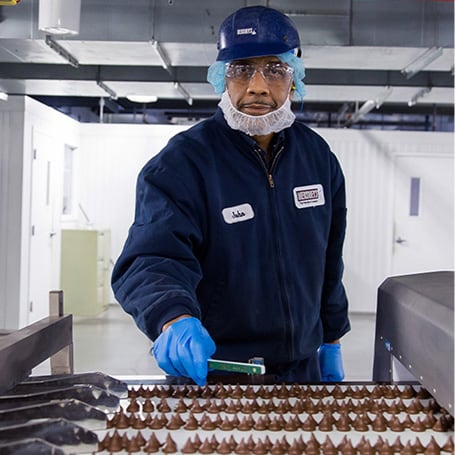
Food safety is the responsibility of everyone at a food manufacturing company – Hershey ensures that we drive the right behaviors around food safety and quality by providing standardized onboarding for all manufacturing facility personnel. We train people in every type of role with:

  • Standardized onboarding for all manufacturing facility personnel, with annual refresher training
  • Food safety basics training as part of our required onboarding for all new salaried employees, which was updated in 2024
  • Training targeted to equip people in specific roles to work and advocate for food safety, such as the onboarding and annual refresher training for Quality Assurance Engineering and R&D personnel 

Food Safety Across Our Value Chain

Hershey sources 100% of ingredients from suppliers approved through the Supplier Quality Management Program. We take a broad look at the supplier’s food safety system and potential risks

given the ingredient type. This ensures compliance with applicable GFSI and regulatory requirements. We also work throughout our value chain to improve practices by helping suppliers achieve GFSI certification.

We also want to promote food safety among consumers and the wider industry. We therefore collaborate with others as a member of the Alliance to Stop Foodborne Illness (ASFI) to provide resources such as free food safety webinars and an online toolkit.

The Safety of Chocolate

Our highest priority is the safety and quality of our products. Hershey products comply with all applicable laws and regulations and are manufactured under strict quality and safety requirements.

Cadmium and lead naturally exist in the environment. As a result, agricultural products – including cacao – can contain trace levels of elements like cadmium and lead. Because these elements are part of our environment, their presence in various foods cannot be entirely avoided.

We do not add cadmium or lead to our products, and we work closely with our suppliers to minimize their presence in our products.

Consumers can rest assured that they may continue to enjoy Hershey products safely.

 

Food Safety FAQs

Food safety is built into every stage of our products’ journey, from ingredient sourcing and product design to manufacturing, packaging and distribution. Hershey’s Product Excellence Program (PEP) helps identify potential risks and establishes controls, monitoring and auditing practices to help ensure the safety and quality of our products. Hershey uses food safety systems based on Hazard Analysis and Critical Control Points (HACCP), and all Hershey-owned manufacturing facilities are certified to Global Food Safety Initiative (GFSI)-recognized standards, including SQF in the U.S., Canada and Mexico, and FSSC 22000 in Brazil, India and Malaysia.

Hershey products must comply with all applicable food safety laws and regulations in the countries where they are sold. We continuously review evolving regulatory requirements and industry best practices to help ensure our food safety and quality programs remain current and effective. Our food safety systems are designed to meet or exceed globally recognized standards, including those recognized by GFSI. Quality professionals at our sites are also certified as Preventive Controls Qualified Individuals (PCQI) by the Food Safety Preventive Controls Alliance (FSPCA), and Hershey participates in industry organizations such as the International Association for Food Protection (IAFP) to stay engaged in food safety best practices.

Products undergo multiple food safety and quality checks throughout the manufacturing process before they are released for sale. Depending on the product, these checks may include microbiological, analytical and sensory testing, along with verification that labeling, packaging and product coding requirements have been met. Products are only released once established food safety and quality requirements have been satisfied.

We source ingredients from suppliers that have been approved through our Supplier Quality Management Program. As part of this process, we evaluate supplier food safety systems, assess ingredient-specific risks and verify compliance with applicable regulatory and GFSI requirements. We also conduct assessments and audits and work with suppliers to strengthen food safety practices across our supply chain.

Food safety standards and requirements are reviewed on an ongoing basis to reflect changing regulations, emerging risks and industry best practices. Many Hershey food safety and quality standards are formally reviewed at least annually, with updates made as frequently as needed to maintain effectiveness and compliance.

If a potential food safety issue is identified, Hershey initiates a structured investigation to assess the situation and determine the appropriate response. This may include product holds, traceability reviews, additional testing, supplier engagement and coordination with regulatory authorities when appropriate. If necessary, established recall procedures are activated to quickly identify and address affected products while prioritizing consumer safety.

Sustainability Issues

Our actions are informed by the issues that matter to our business and stakeholders. We are focused on the issues where we can make the greatest impact.

Progress on Priorities

We are working toward several ambitious goals designed to help us create a stronger, more resilient business. We publicly track and report our progress to stay transparent and accountable.