Responsible Sourcing Supplier Program
Hershey works with thousands of suppliers and business partners around the world every day who help us make our iconic treats that consumers love. These relationships span ingredient and packaging suppliers, contract manufacturers, contract packers, service providers and licensees. We expect our suppliers to operate with integrity, respect human rights, and share our commitment to ethical and responsible business practices.
Our Responsible Sourcing Supplier Program is core to how we conduct human rights and environmental due diligence across our Tier 1 manufacturing and service suppliers. We aim to assess, monitor and manage labor standards, worker well-being, health and safety, business ethics, and environmental compliance across our Tier 1 suppliers in line with our Supplier Code of Conduct.
Hershey recognizes the size and complexity of our global supply chain spanning from manufacturers, distributors and processers to large-scale agricultural sites, family farms and smallholders. While it is not currently feasible for us to monitor compliance of every supplier in our global supply chain, our approach prioritizes risk-based due diligence. We also collaborate with suppliers on continuous improvement through corrective action plans and capability building where needed to drive positive and lasting change for our people, the planet and the long-term sustainability of our supply chain.
Our Responsible Sourcing Supplier Program Approach
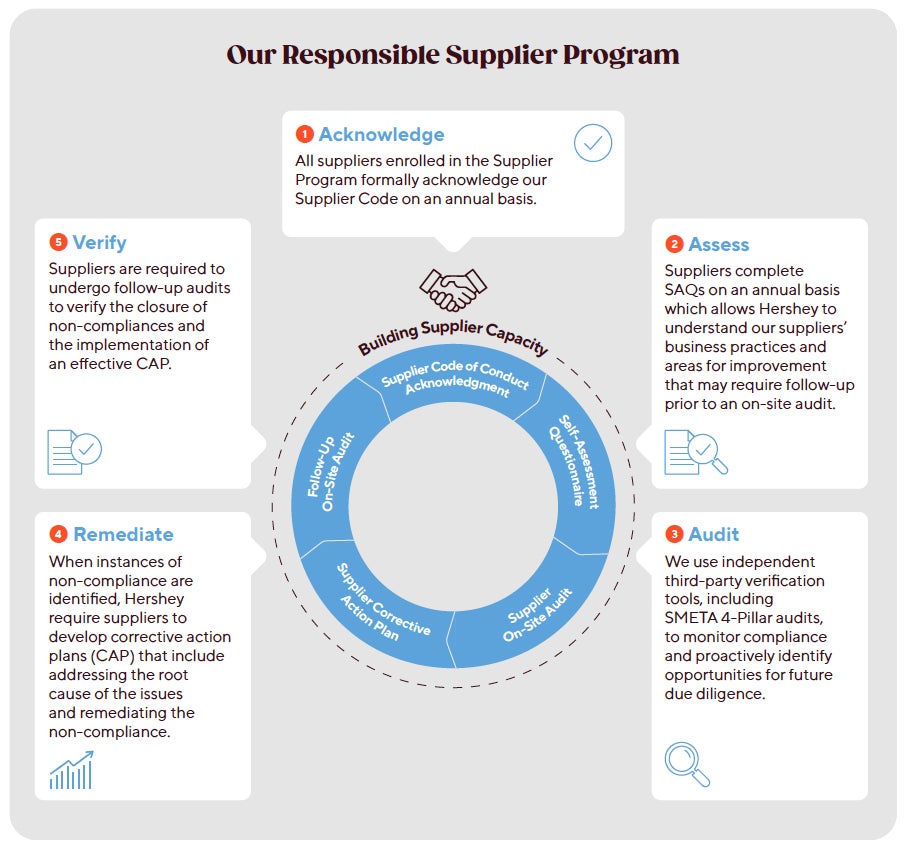
Our Responsible Sourcing Supplier Program follows a five-step process.
1. Supplier Code Acknowledgement
Suppliers enrolled in the program are required to formally acknowledge Hershey’s Supplier Code of Conduct on an annual basis. The Supplier Code is available in multiple languages to support clear understanding across our global supply base.
Our Supplier Code outlines Hershey’s requirements and expectations with respect to responsible sourcing including our commitments to human rights, the environment, health and safety, business ethics and the development of a diverse and sustainable supply chain.
The Supplier Code of Conduct can be downloaded in multiple languages: Bahasa Melayu, Chinese, French, Japanese, Korean, Portuguese, Spanish, Tamil and Telugu.
To further support suppliers, we provide a Supplier Program Guidebook explaining program requirements, audit expectations, and define Critical and Zero Tolerance violations
The Supplier Program Guidebook can be downloaded in multiple languages: Bahasa Melayu, Chinese, French, Hindi, Japanese, Korean, Portuguese, Spanish, Tamil and Telugu.
2. Self-Assessment and Risk Assessment
Suppliers are required to complete an annual Self-Assessment Questionnaire (SAQ). SAQs are an important tool for Hershey to hear directly from suppliers on their own programming efforts and responsible sourcing journeys. This allows us to better understand suppliers’ management systems, identify potential gaps, and determine follow-up actions that may be recommended to implement prior to an on-site audit. As described in our Supplier Program Guidebook, Hershey prioritizes the Sedex SAQ as Sedex is a leading nonprofit focused on improving ethical performance in corporate supply chains.
Hershey assesses our Tier 1 suppliers and sites to continuously enroll those who we identify as high-risk or high priority into this due diligence program. The supplier risk assessment tool, developed in partnership with human rights NGO Verité, covers four categories of risks: human rights risks based on geography; human rights risks based on value chain; volume of Hershey spend; and supplier continuity risks. We use this tool to assess our Tier 1 ingredient and raw material and packaging suppliers, co-manufacturers, co-packers, licensees and labor service providers.
Responsible sourcing and human rights risk screenings are also conducted before entering new commercial relationships with ingredient and packaging suppliers; contract manufacturer; contract packers; and Licensing manufacturing sites. The pre-screening process reviews the prospective supplier’s SAQ and/or social compliance audit, depending on risk profile, to assess their management systems related to human rights and labor, health and safety, environment, and business ethics. Potential suppliers may be required to submit corrective actions and/or undergo follow-up verification audits prior to an approval or rejection decision.
3. Social Compliance Audits
On-site social compliance audits are a central component of our due diligence approach. These audits provide visibility into supplier performance across the topics of:
- Labor standards and working conditions
- Occupational health and safety
- Environmental practices
- Business ethics
Suppliers in the program are required to undergo a SMETA 4-pillar audit or equivalent, conducted by an approved third-party monitoring firm. Audits are to be conducted during a three-week semi-announced audit window and include night shift workers. As a member of AIM-Progress, Hershey also supports the process of mutual recognition to reduce audit duplication, fatigue and cost.
Audit performance is assessed using Hershey’s internal grading methodology to determine follow-up actions, timelines, and escalations where needed. Audit results inform follow-up requirements, timelines, and escalations. The audit process opens a dialogue between Hershey and our suppliers for sharing concerns, best practices and opportunities for training and investment in support of continuous improvement.
We acknowledge that audits are just one among several tools needed for robust due diligence. We continue industry engagement via AIM-Progress and Sedex to evaluate both the role of audits and the most effective way to implement them, as well as other due diligence tools, to identify human rights risks in our Tier 1 supply chain.
4. Corrective Actions, Remediation and Continuous Improvement
When non-compliances are identified, suppliers are required to develop and implement Corrective Action Plans (CAPs) that address the issue and its root cause. Hershey works and collaborates with suppliers directly and through our involvement with Sedex and AIM-Progress to:
- Track corrective actions and remediation progress
- Identify opportunities for training and capability building
- Support continuous improvement over time
Our focus is on supporting meaningful change for workers while maintaining supplier accountability when expectations are not met.
5. Follow-Up and Verification
Suppliers must complete follow-up audits to verify the effective closure of non-compliances. Results inform future audit cadence, sourcing decisions, and supplier engagement priorities.
We report on our program and supplier capability building progress, learnings, and data in our Responsible Business Report and Statement Against Slavery and Human Trafficking.
Hershey Owned Facilities Social Compliance Approach
Our commitment to a responsible supply chain applies equally to Hershey-owned facilities. All Hershey manufacturing plants undergo SMETA 4-Pillar audits. These are conducted under a three-week semi-announced audit window. Audits at facilities with night shift operations include night shift workers in the audit scope. Additionally, labor and service providers at Hershey facilities are included in the audit scope.
We follow a performance-driven audit cadence, meaning follow-up and periodic audit requirements and timing are informed by audit outcomes rather than a fixed schedule. When findings are identified, corrective action plans and follow-up audits are required.
Learn more about our due diligence efforts with labor and service providers at Hershey-owned facilities on our “Responsible Recruitment & Employment” webpage.
Transparency and Ongoing Progress
We disclose our Responsible Sourcing Supplier Program and Owned Facilities approach, progress, and challenges through our Responsible Business Report and Statement Against Slavery and Human Trafficking, and we continue to refine our program as risks, regulations, and expectations evolve.