April 20, 2026
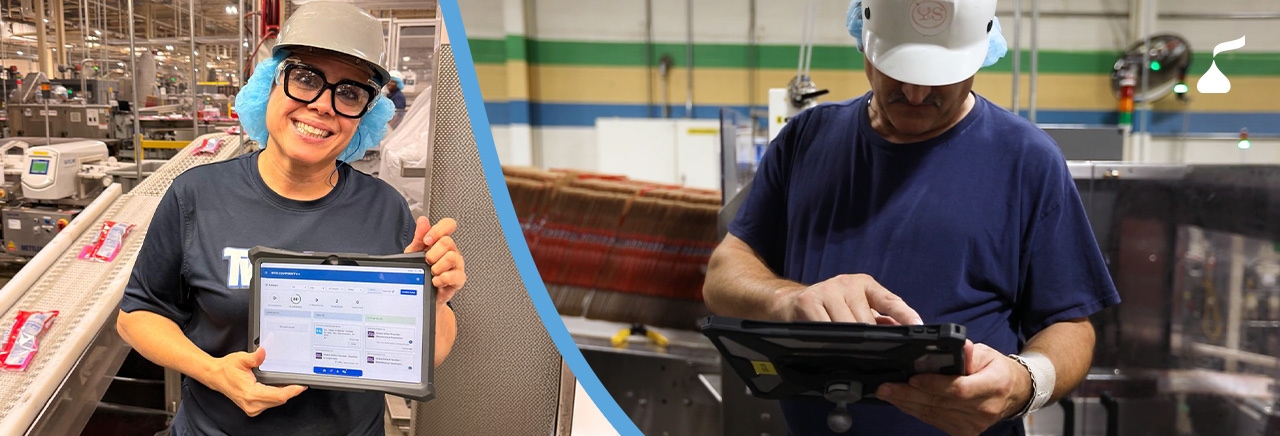
At The Hershey Company, we’ve laid a strong foundation for our digital transformation in manufacturing. We understand that true transformation comes when people are empowered with the right information at the right time, and that’s the mission of Connected Worker, the next phase in Hershey’s strategy, which equips factory teams with mobile tools that allow for real-time insights, accelerated trainings and improved communications across the board.
We know that factories, in general, are 10 to 15 years behind consumer electronics, so this is something there’s a lot of appetite for. In every plant we’ve rolled Connected Worker out in, we’ve seen a lot of excitement and energy around this tool and what it delivers. As our community at large hears about these changes, there’s also a lot of curiosity. Here are answers to some of the most common questions my team receives about Connected Worker, and what this evolution means for Hershey, its customers and consumers.
What is Connected Worker, and why is this a priority for Hershey?
Connected Worker is a term that's used to describe something that puts mobile devices in the hands of production operators so that they are connected to the data coming from the factory operations, they’re connected to information that is relevant to their jobs and they’re connected to each other. We call it the “one pane of glass” that allows for communications throughout the factory, because it brings together data from various systems, sources and applications so that our operators have the right information available to them to make decisions. It’s built on generative AI, so it has the capability to do a lot of different things.
Advancing our digital and technology capabilities is a priority for Hershey because it allows for a competitive advantage, both in terms of productivity and savings, at a level that we haven't in the past.
What are some of the specific changes this technology is bringing to factory operators?
It’s moving manufacturing work from paper and binders to intuitive digital tools. Before Connected Worker, there was a heavy reliance on paper checklists and printed manuals. Operator communications didn’t flow efficiently. Training and other documentation were sometimes inconsistent and incomplete. Often, knowledge was transferred informally, from one person to another.
Now, with Connected Worker, operators are digitally connected via mobile devices to their production data, their training and documentation and to each other. They have real-time access to systems, guidance and information and experiences are consistent and repeatable across shifts, roles and plants.
Aside from connectedness throughout the factory, what are some other ways that this tool is being used?
Knowledge and training is one important area. These tools allow for the creation of material using generative AI capabilities, so you can film or describe an activity, and then the tool can generate the work process at hand. Workers can then search for those videos and guides, which enables faster onboarding, continuous learning and knowledge preservation. The technology also allows for easy access to information when and where you need it. For example, a QR code on a piece of equipment can bring up related information about training and qualifications. And, because this information is all digitized, it allows you to store it and access it in the future.
Who else benefits from the technology?
It has implications across the whole enterprise. Maintenance, for example, is able to track requests clearly and transparently, which enables the team to prioritize and coordinate as needed. And operators can see the maintenance status of their equipment, instead of waiting and wondering as they did in the past.
Supervisors also benefit, because the data is streamlined and they have real-time visibility into what’s happening all around them, with regards to performance; they’re also better connected to their operators and teams. This enables them to spend more time coaching and supporting people, and less time chasing information.
What’s the timeline for implementation?
So far, we’ve rolled out the capability in six of our factories. We expect to reach all of our manufacturing facilities—both salty snacks factories and confection factories—within the next 18 months.
What does success look like for Connected Worker?
Success starts with our people. It means operators, maintenance technicians, and manufacturing teams across our global network actively using the Connected Worker platform because it genuinely makes their jobs easier, safer, and more effective. The system becomes a natural part of daily work, supporting clear standards, consistent processes, and real-time access to knowledge where and when it matters most.
By strengthening process discipline and enabling teams to do their best work every day, Connected Worker elevates the quality of the work environment and increases engagement and job satisfaction on the shop floor. These people-first outcomes translate into measurable business value: reduced waste, higher efficiency, increased line output, and more consistent performance across our global manufacturing operations.
How might the benefits extend beyond the walls of Hershey?
A better operation results in better service for our customers. So reliability and consistency from our factories to deliver on time and in full will result in better service for our customers and better outcomes for consumers. That means our items are on the shelf when they need to be and with the right quality to deliver the experience that people expect from our brands.
Want to learn more about Hershey’s manufacturing initiatives? Check back for our next blog on decision intelligence.