
April 22, 2026
This Earth Day, we’re introducing our new enterprise sustainability strategy, one designed to carry Hershey into its next chapter with purpose and confidence. As we continue to grow and adapt, our focus on long-term success goes hand in hand with how we show up for people and our planet.
As Hershey has expanded its portfolio and global footprint, we’ve refined how we operate, sharpening our approach to managing risk, strengthening supply reliability and building the resilience needed to support long-term growth. That progress has shaped the business we are today and sets the foundation for where we’re headed next.
The world is asking more of businesses. Communities are navigating the impacts of climate change and ecosystem pressures, while expectations from consumers, customers and stakeholders continue to rise. Sustainability efforts and business performance are not always parallel pursuits; at times, they create real tension. But by working through that complexity with intention, we believe stronger, more resilient companies emerge.
Our updated sustainability strategy reflects that reality. It builds on the progress and lessons of the past, while taking a more integrated enterprise-wide approach to addressing the environmental and social challenges that intersect with our business. Looking ahead to the next decade, the strategy helps shape how we source ingredients and make our products, enabling us to continue delighting consumers while growing responsibly in a changing world.
Together, Source, Make, and Delight define our updated sustainability strategy, guiding how we operate today and how we grow responsibly for the future.
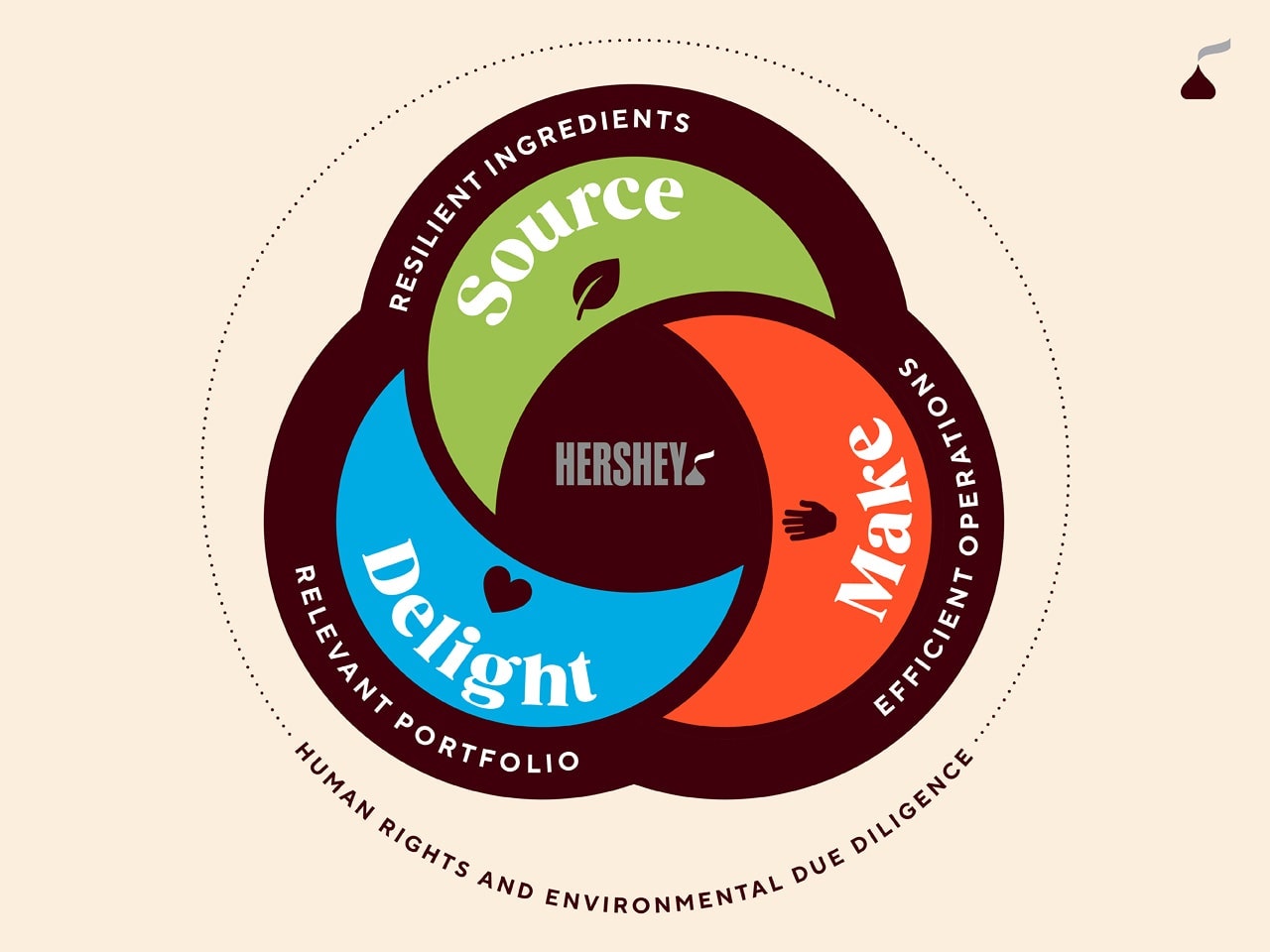
Source
Our products depend on a diverse set of ingredients sourced from multiple geographies, from cocoa in West Africa to dairy and peanuts in the United States, each shaped by distinct environmental and social conditions.
Many of the ingredients we rely on are grown in regions facing interconnected environmental challenges, including climate variability, water stress, deforestation and biodiversity loss. Cocoa, for example, is highly sensitive to changing rainfall patterns in the regions where it grows. Diseases and other environmental factors that affect plant health can reduce yields and quality, ultimately impacting crops and the livelihoods of farm families.
Our strategy recognizes that supply chain resilience starts with farms and farmers, but also depends on the health of the broader ecosystems in which they operate.
We are investing in programs that strengthen both. Through our Hershey Income Accelerator Program (HIAP), a $40 million initiative in Côte d'Ivoire, we aim to support 20,000 farming households with training, financial incentives, and tools to improve productivity and incomes. Learnings from HIAP have informed the evolution of our sustainability strategy, reinforcing the importance of a farmer-centric approach that intentionally links environmental outcomes with social and income resilience.
Alongside this, we are investing in the long-term health of agricultural systems. This includes a goal to cover one million hectares with regenerative, restorative or protective practices by 2035. In peanut-growing regions in the United States, we’re helping sustain the water resources that underpin long-term peanut production through a new playa restoration program launched in partnership with Texan By Nature.
At the same time, we are strengthening broader supply chain responsible sourcing and human rights due diligence by maintaining proven approaches such as Child Labor Monitoring and Remediation Systems that help identify, prevent and address risks to support the wellbeing of people across our value chains.
Together, these investments help ensure that the ingredients we depend on and the communities behind them can thrive.
Make
Our ability to make and deliver great-tasting snacks to millions of consumers depends on how well we optimize our operations, logistics, and supply chain network to reduce waste and minimize our environmental footprint. Efficient operations are more than just a business imperative; they're also a commitment to our consumers, our communities and our planet. By developing a culture focused on eliminating waste across our global manufacturing network, we are ensuring that sustainability is at the center of how we make our iconic treats.
Our efforts to improve operational efficiency and reduce our environmental footprint include a 50% absolute reduction in Scope 1 and 2 emissions by 2030, sourcing 100% of our electricity from renewable and zero-emissions sources by 2030 and eliminating 25 million pounds of packaging across our portfolio.
At the same time, we are improving our performance on the ground through targeted investments in water recycling systems at our facilities and by optimizing our logistics network to reduce fuel use and miles traveled. These efforts are helping us progress toward a more efficient, responsible business.
Delight
For more than 130 years, Hershey has been making products people love. That means constantly evolving to meet changing consumer expectations. Today, consumers are thinking more holistically about what they eat, and are considering health, sustainability and transparency alongside taste and value.
Our portfolio has been growing to offer consumers even more snacking options, and we're working to integrate sustainability considerations into our portfolio design. Five of our last seven acquisitions have expanded our presence in better-for-you snacking, including protein, organic and zero-sugar options. Today, a growing share of our portfolio includes portion-conscious products and options with no added sugar, helping make these choices more accessible.
That evolution also means rethinking how sustainability shows up across our portfolio, as consumers increasingly look for products that reflect their values. By integrating sustainability considerations more intentionally into how we design and develop our offerings, we’re working to deliver the choice and experiences consumers want today and in the future.
We are also making changes that consumers can see. Advancing sustainable packaging through material reduction, designing for recyclability and recycled content inclusion are just a few examples. In addition, we’re building the data and tools needed to navigate an increasingly complex regulatory landscape.
Across this work, our goal is to bring together great taste and responsible business practices in ways that are meaningful to consumers and meet their expectations.
As we celebrate Earth Day, we’re happy to share this new enterprise sustainability strategy because it reflects where we are today, and our commitment to working every day to build a business that is resilient, responsible and ready for the future.