July 30, 2026
Today, roughly one in nine U.S. adults is taking a GLP-1 to lose weight, according to a recent Gallup poll. As those medications reshape appetites and habits, our Consumer Insights team has been surveying thousands of GLP-1 users about what they’re experiencing. Our goal is to better understand the ways the drugs are reshaping the way people eat, shop and spend, so Hershey can continue playing a meaningful role in consumers’ ever-evolving lives.
Recently, we completed a series of interviews with individuals, and in some cases with groups of friends, who are using GLP-1 medications. This is one of my favorite ways to do qualitative research, because we get to visit an individual’s home and talk to their social circles candidly. As they banter, we get to know what’s on their mind — and in their pantries — unlocking powerful insights.
We invited Hershey’s executive leadership team to come along. We all walked away with a deeper grasp of what’s important to consumers.
Here are some of the questions that were on our mind during these sessions, and the insights we took back to Hershey.
How do GLP-1s impact the way consumers think about food?
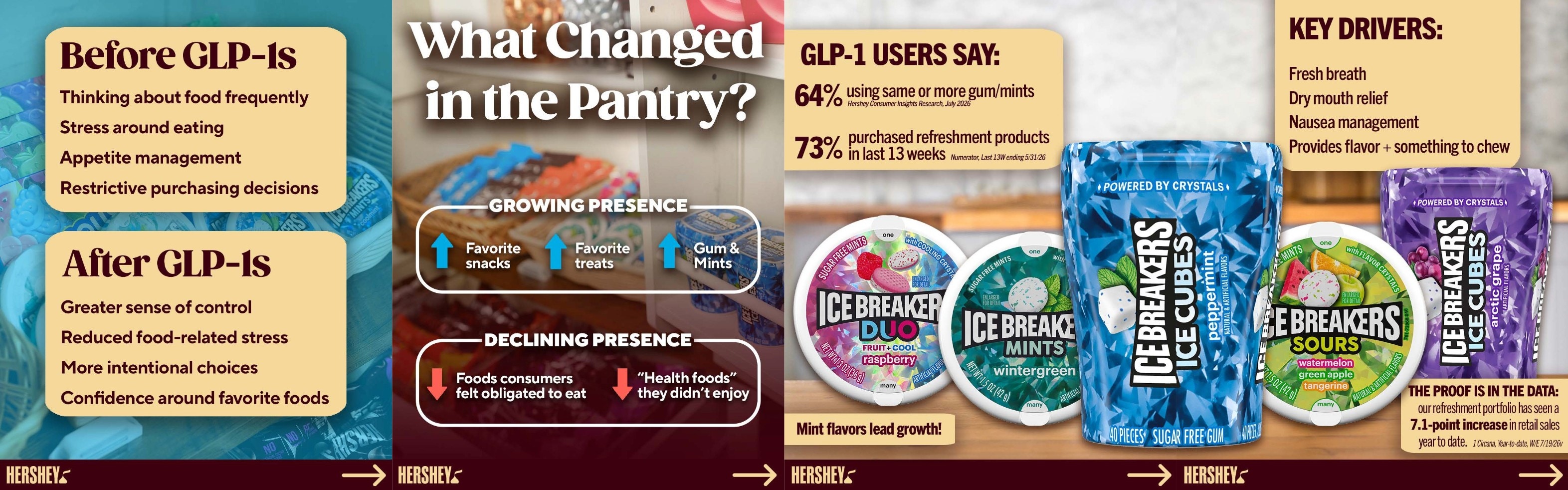
GLP-1s have altered how people relate to food. We heard the same message time and again: the food noise goes away. Previously, eating occupied their minds and caused a fair amount of stress. Now, for many of them, the noise and stress are gone, and they feel more in control at home and in social settings. They’re still reaching for the treats they love — many told us they feel freer to enjoy them, without the guilt that used to hold them back.
Are consumers on GLP-1s still indulging?
Absolutely. We’ve seen confection as more insulated than center-of-plate categories because GLP-1 users are still enjoying their favorite treats. Many of the people we spoke with said they actually feel more freedom to have the foods they love in their house because they’re able to indulge, feel satisfied and move on, without guilt. One consumer shared a story that really drove that point home: they used to buy cottage cheese, which they hated, but felt like they had to eat. Now, they feel confident they can have a bag of chips or package of cookies in the house. It’s a pattern we’re seeing across our own permissible and salty snack brands, too. These categories are proving resilient, giving consumers an easy, lighter way to snack without derailing their goals.
How are GLP-1s fueling growth in gum and mints?
We already knew from our research that many GLP-1 users are turning to gum and mints for breath freshness, to treat dry mouth and to prevent nausea. During our conversations, we heard a number of people talk about a kind of fixation on chewing. They’re eating smaller portions, and they’re not hungry, but they still have this desire to chew, so mints and gum are satisfying. Some people also want just a taste of something sweet, but they don’t want to feel full. The proof is in the data: our refreshment portfolio has seen a 7.1-point increase in retail sales year to date.1
Are GLP-1 users spending on groceries differently than before medication?
While some of the individuals using the GLP-1 medications may be eating smaller portions, household consumption of our brands has remained strong, even as individual eating habits shift.
Many of the people we spoke with are still cooking and buying for the whole household, a reminder that GLP-1s are changing individual habits, not household demand. Plus, a lot of the people we talked to have teenagers living in the house, and they pointed out that the teens are going to eat whatever’s in the pantry. Research also shows that GLP-1 users are more willing to indulge in candy and snacks now that these moments are truly a treat.
We are seeing snacking habits change, and that’s true for GLP-1 users as well as younger generations. Snacks are still playing an important role throughout the day, whether they’re eaten between meals or taking the place of meals. Overall, we don’t think the impact on food purchasing and food consumption is as drastic as some predicted early on.
So, what is in their pantries?
GLP-1 users told us that their favorites continue to play a starring role in the main stage of their pantry. What is different is there may be even more of those favorites and significantly less of the products they felt compelled to eat to hit their health and wellness goals. After all, we all probably have our own version of the cottage cheese example.
From 1894 to the GLP-1 Era, we’re still making moments of goodness
More than anything, these interviews really validate the relevance of our full portfolio, even as GLP-1 users redefine how and when they enjoy their favorites.
For years, we’ve been investing in areas such as functional (including protein), permissible and better-for-you, with exciting things yet to come for Premium. Whether moving to colors from natural sources or bringing fan-loved snacking combos to life like Reese’s Oreo and Dot’s Snack Mix, it all starts with listening to consumers. The diversity of our brands means we have something for every occasion, whether an individual wants to treat themselves with a piece of candy, munch on popcorn or enjoy a refreshing mint. When they reach for a moment of goodness, they’ll find Hershey.
1 Circana, Year-to-date, W/E 7/19/26